- Overview
- Configuration
- NTP4 Plug-In
- Hardware
- RFC 868
- RFC 2030
-
RFC 1305
- RFC 1305
- 1. Introduction
- 1.1 Related Technology
- 2. System Architecture
- 2.1 Implementation Model
- 2.2 Network Configurations
- 3. Network Time Protocol
- 3.1 Data Formats
- 3.2 State Variables and Parameters
- 3.2.1 Common Variables
- 3.2.2 System Variables
- 3.2.3 Peer Variables
- 3.2.4 Packet Variables
- 3.2.5 Clock-Filter Variables
- 3.2.6 Authentication Variables
- 3.2.7 Parameters
- 3.3 Modes of Operation
- 3.4 Event Processing
- 3.4.1 Notation Conventions
- 3.4.2 Transmit Procedure
- 3.4.3 Receive Procedure
- 3.4.4 Packet Procedure
- 3.4.5 Clock-Update Procedure
- 3.4.6 Primary-Clock Procedure
- 3.4.7 Initialization Procedures
- 3.4.7.1 Initialization Procedure
- 3.4.7.2 Initialization-Instantiation Procedure
- 3.4.7.3 Receive-Instantiation Procedure
- 3.4.7.4 Primary Clock-Instantiation Procedure
- 3.4.8 Clear Procedure
- 3.4.9 Poll-Update Procedure
- 3.5 Synchronization Distance Procedure
- 3.6 Access Control Issues
- 4. Filtering and Selection Algorithms
- 4.1 Clock-Filter Procedure
- 4.2 Clock-Selection Procedure
- 4.2.1 Intersection Algorithm
- 4.2.2. Clustering Algorithm
- 5. Local Clocks
- 5.1 Fuzzball Implementation
- 5.2 Gradual Phase Adjustments
- 5.3 Step Phase Adjustments
- 5.4 Implementation Issues
- 6. Acknowledgments
- 7. References
- Appendix A
- Appendix B
- Appendix C
- Appendix D
- Appendix E
- Appendix F
- Appendix G
- Appendix H
- Appendix I
- Time Tools
- NTP Auditor
- About
| Previous Top Next |
Windows Time Server
2.1 Implementation Model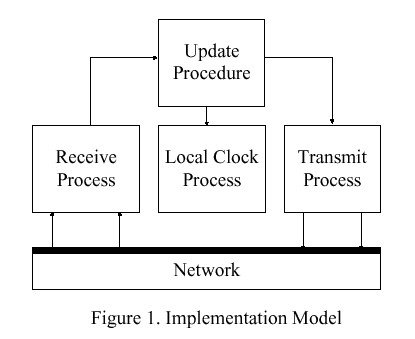
In what may be the most common client/server model a client sends an NTP message to one or more servers and processes the replies as received. The server interchanges addresses and ports, overwrites certain fields in the message, recalculates the checksum and returns the message immediately. Information included in the NTP message allows the client to determine the server time with respect to local time and adjust the local clock accordingly. In addition, the message includes information to calculate the expected timekeeping accuracy and reliability, as well as select the best from possibly several servers.
While the client/server model may suffice for use on local nets involving a public server and perhaps many workstation clients, the full generality of NTP requires distributed participation of a number of client/servers or peers arranged in a dynamically reconfigurable, hierarchically distributed configuration. It also requires sophisticated algorithms for association management, data manipulation and local-clock control. Throughout the remainder of this document the term host refers to an instantiation of the protocol on a local processor, while the term peer refers to the instantiation of the protocol on a remote processor connected by a network path.
Figure 1 shows an implementation model for a host including three processes sharing a partitioned data base, with a partition dedicated to each peer, and interconnected by a message-passing system. The transmit process, driven by independent timers for each peer, collects information in the data base and sends NTP messages to the peers. Each message contains the local timestamp when the message is sent, together with previously received timestamps and other information necessary to determine the hierarchy and manage the association. The message transmission rate is determined by the accuracy required of the local clock, as well as the accuracies of its peers.
The receive process receives NTP messages and perhaps messages in other protocols, as well as information from directly connected radio clocks. When an NTP message is received, the offset between the peer clock and the local clock is computed and incorporated into the data base along with other information useful for error determination and peer selection. A filtering algorithm described in Section 4 improves the accuracy by discarding inferior data.
The update procedure is initiated upon receipt of a message and at other times. It processes the offset data from each peer and selects the best one using the algorithms of Section 4. This may involve many observations of a few peers or a few observations of many peers, depending on the accuracies required.
The local-clock process operates upon the offset data produced by the update procedure and adjusts the phase and frequency of the local clock using the mechanisms described in Section 5. This may result in either a step-change or a gradual phase adjustment of the local clock to reduce the offset to zero. The local clock provides a stable source of time information to other users of the system and for subsequent reference by NTP itself.